Desert bees: Local histories of changing environments (2026 - 2027)
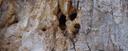
The foto shows the nest site of the stingless bee Hypotrigona ruspolii, with its characteristic entrance tube, in a tree in the Air Mountains, Niger.
With the onset of Holocene climate change 5,000–6,000 years ago, the once green and water-rich Central Sahara became the hyper-arid desert it is today. Numerous animal and plant species disappeared, whilst others survived in refuges and later adapted to the new conditions. The latter include several species of hymenoptera, which we commonly refer to as ‘bees’: the solitary mortar bees (Megachilidae), or the colony-forming, honey-producing stingless bees (Apidae). What are the adaptation strategies of these species to extreme environments, and how are they affected by the new recent climate change? The histories of these species are closely interwoven with the evolution of habitats and with human-animal-plant interactions within them. Such histories lie at the intersection of numerous disciplines, e.g. zoology, botany, climate science and, not least, anthropology. Drawing in particular on local knowledge and palynology, and in cooperation with the Honeybee Research Unit at the University of Bremen, we seek to retell, from the perspective of the Desert Bees, local histories of changing environments and their inhabitants.
FURTHER READING
Schulz, E., Musch, T. Brückner, D., Ibrahim, S., Rasmussen, C. 2025. Honey in West Africa. More than a niche economy? Zentralblatt für Geologie und Paläonthologie, I 2025 (1): 67-95. https://doi.org/10.1127/zgpI/2025/0006
Musch, T. 2023. Meliponines in the Hyper-arid Desert: Evidences of Hypotrigona ruspolii (Magretti, 1898) in the Air Mountains, Central Sahara. Enthomologie heute 34: 1-6.
Musch, T., Brückner, D. 2020. Clayton rings and ancient beekeeping. An ethno-zoological contribution. Journal of Global Archaeology 2020: § 1-28. https://doi.org/10.34780/joga.v2020i0.1004