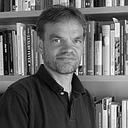
Akad. Rat Dr. Uwe Czaniera
Phone: +49 (0)921 / 55-4162
e-Mail: Uwe.Czaniera@uni-bayreuth.de
Building GW II, room 01.03
Universität Bayreuth
Universitätsstr. 30
D-95447 Bayreuth
office hours: upon appointment
- General Philosophy of Science (Verificationism, Critical Rationalism, Coherentism)
- Theories of Ethics (Consequentialism, Deontologism, Virtue Ethics)
- Metaethics (Cognitivism vs. Noncognitivism)
- Philosophy of Mind
- Special questions in the Philosophy of Science (Science vs. Pseudo-Science, History of the Natural Sciences, Relation between the Natural Sciences and Philosophy, Role of Thought Experiments)
- Bioethics
Born in Bremen in 1967, I started studying philosophy there in 1988. I was mainly interested in questions of bioethics, but due to the heated debate around Peter Singer’s “Practical Ethics” I developed an interest in the question how to justify moral principles in the first place. Thus I was led into metaethics and the philosophy of science.
I came to Bayreuth in 1996 where I completed my Ph.D. thesis in 2000. The resulting book Gibt es moralisches Wissen? (Is there Moral Knowledge?) is concerned with the so-called “cognitivism debate” in metaethics. It argues that although there is no moral knowledge in a sense that may be compared to scientific knowledge, it may well be possible to distinguish between reasonable and non-reasonable moral principles. The heroes of this book are David Hume and Richard Hare.
Since 2000 I have been involved in the development of the P&E programme. I have always been convinced that a well-run P&E programme could contribute much not only to the academic, but also to the real world. I am very much at home in the P&E engine room (as well as in my wood workshop at home). Nevertheless, my main focus is on my dog, Arthus.
What I know something about
My main areas are:
Other topics I am interested in:
If you would ask me to recommend some authors in philosophy, I would name David Hume, Ludwig Wittgenstein, Karl Popper, John Leslie Mackie, Richard Hare and Gerhard Vollmer.
Han shoots first!
Born in Bremen in 1967, I started studying philosophy there in 1988. I was mainly interested in questions of bioethics, but due to the heated debate around Peter Singer’s “Practical Ethics” I developed an interest in the question how to justify moral principles in the first place. Thus I was led into metaethics and the philosophy of science.
I came to Bayreuth in 1996 where I completed my Ph.D. thesis in 2000. The resulting book Gibt es moralisches Wissen? (Is there Moral Knowledge?) is concerned with the so-called “cognitivism debate” in metaethics. It argues that although there is no moral knowledge in a sense that may be compared to scientific knowledge, it may well be possible to distinguish between reasonable and non-reasonable moral principles. The heroes of this book are David Hume and Richard Hare.
Since 2000 I have been involved in the development of the P&E programme. I have always been convinced that a well-run P&E programme could contribute much not only to the academic, but also to the real world. I am very much at home in the P&E engine room (as well as in my wood workshop at home). Nevertheless, my main focus is on my dog, Arthus.
What I know something about
My main areas are:
- General Philosophy of Science (Verificationism, Critical Rationalism, Coherentism)
- Theories of Ethics (Consequentialism, Deontologism, Virtue Ethics)
- Metaethics (Cognitivism vs. Noncognitivism)
Other topics I am interested in:
- Philosophy of Mind
- Special questions in the Philosophy of Science (Science vs. Pseudo-Science, History of the Natural Sciences, Relation between the Natural Sciences and Philosophy, Role of Thought Experiments)
- Bioethics
If you would ask me to recommend some authors in philosophy, I would name David Hume, Ludwig Wittgenstein, Karl Popper, John Leslie Mackie, Richard Hare and Gerhard Vollmer.
Han shoots first!
From 1993 to 1995 I was involved in the LOGO FILM project. We conducted interviews with major figures in philosophy (Richard Hare, Willard Van Orman Quine, Hans Albert etc.) and assembled them to a film that should give a vivid picture of the methods and point of analytic philosophy. You may view the film (which is in German) online in the Youtube video section of the German Society for Analytic Philosophy (GAP) (shame that they had to replace the original Mozart soundtrack):
Teil I: Was machen Philosophen?
Teil II: Die Geschichte der Analytischen Philosophie
Teil III: Anwendung - Künstliche Intelligenz
Teil IV: Anwendung - Ethik
Teil V: Logik - Begründung - Erklärung
Teil VI: Warum Philosophie?
You may also read some of the interviews here (more to come):
Hans Albert: Der Lügenbaron und die Letztbegründung (01.10.1993)
From 1993 to 1995 I was involved in the LOGO FILM project. We conducted interviews with major figures in philosophy (Richard Hare, Willard Van Orman Quine, Hans Albert etc.) and assembled them to a film that should give a vivid picture of the methods and point of analytic philosophy. You may view the film (which is in German) online in the Youtube video section of the German Society for Analytic Philosophy (GAP) (shame that they had to replace the original Mozart soundtrack):
Teil I: Was machen Philosophen?
Teil II: Die Geschichte der Analytischen Philosophie
Teil III: Anwendung - Künstliche Intelligenz
Teil IV: Anwendung - Ethik
Teil V: Logik - Begründung - Erklärung
Teil VI: Warum Philosophie?
You may also read some of the interviews here (more to come):
Hans Albert: Der Lügenbaron und die Letztbegründung (01.10.1993)
Born in Bremen in 1967, I started studying philosophy there in 1988. I was mainly interested in questions of bioethics, but due to the heated debate around Peter Singer’s “Practical Ethics” I developed an interest in the question how to justify moral principles in the first place. Thus I was led into metaethics and the philosophy of science.
I came to Bayreuth in 1996 where I completed my Ph.D. thesis in 2000. The resulting book Gibt es moralisches Wissen? (Is there Moral Knowledge?) is concerned with the so-called “cognitivism debate” in metaethics. It argues that although there is no moral knowledge in a sense that may be compared to scientific knowledge, it may well be possible to distinguish between reasonable and non-reasonable moral principles. The heroes of this book are David Hume and Richard Hare.
Since 2000 I have been involved in the development of the P&E programme. I have always been convinced that a well-run P&E programme could contribute much not only to the academic, but also to the real world. I am very much at home in the P&E engine room (as well as in my wood workshop at home). Nevertheless, my main focus is on my dog, Arthus.
What I know something about
My main areas are:
- General Philosophy of Science (Verificationism, Critical Rationalism, Coherentism)
- Theories of Ethics (Consequentialism, Deontologism, Virtue Ethics)
- Metaethics (Cognitivism vs. Noncognitivism)
Other topics I am interested in:
- Philosophy of Mind
- Special questions in the Philosophy of Science (Science vs. Pseudo-Science, History of the Natural Sciences, Relation between the Natural Sciences and Philosophy, Role of Thought Experiments)
- Bioethics
If you would ask me to recommend some authors in philosophy, I would name David Hume, Ludwig Wittgenstein, Karl Popper, John Leslie Mackie, Richard Hare and Gerhard Vollmer.
Han shoots first!
From 1993 to 1995 I was involved in the LOGO FILM project. We conducted interviews with major figures in philosophy (Richard Hare, Willard Van Orman Quine, Hans Albert etc.) and assembled them to a film that should give a vivid picture of the methods and point of analytic philosophy. You may view the film (which is in German) online in the Youtube video section of the German Society for Analytic Philosophy (GAP) (shame that they had to replace the original Mozart soundtrack):
Teil I: Was machen Philosophen?
Teil II: Die Geschichte der Analytischen Philosophie
Teil III: Anwendung - Künstliche Intelligenz
Teil IV: Anwendung - Ethik
Teil V: Logik - Begründung - Erklärung
Teil VI: Warum Philosophie?
You may also read some of the interviews here (more to come):
Hans Albert: Der Lügenbaron und die Letztbegründung (01.10.1993)